
INSIGHT Psychodynamic Psychotherapy One-Year Training
A flexible module based training program for experienced clinicians
Features
This program is structured to allow participants to complete the overall program or choose and engage with individual modules based on their specific areas of interest or professional needs.
- Group supervision - Small group learning. (maximum 8)
- Theory integrated with case studies
- Collaborative and experiential learning
Certification:
Submit reflections to earn a Certificate of Attainment, meeting AHPRA's Active PD criteria.
Earn 16 Active Learning CPD hours per module.
2026 Dates:
Module 1: 2 February to 30 March (Week's Break 2 March)
Module 2: 13 April to 8 June (Week's Break 4 May)
Module 3: 13 July to 7 September (Week's Break 10 August)
Module 4: 12 October to 7 December (Week's Break 9 November)
Time: 6.00 - 8.00 pm Brisbane time (AEST)
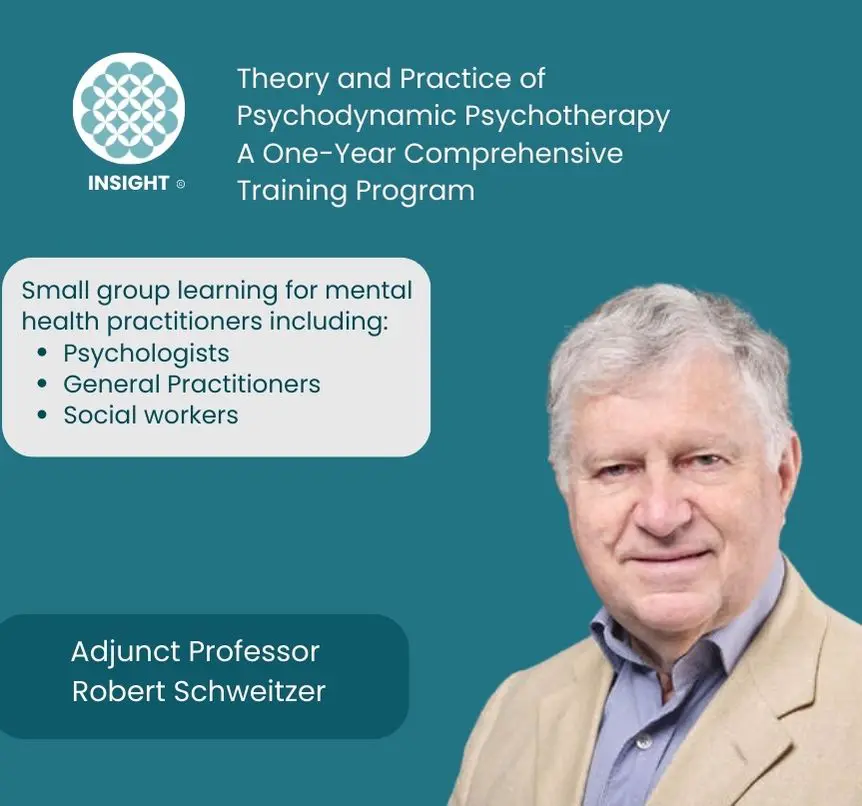

A One-Year Comprehensive Training Program
This one-year course is tailored for experienced practitioners seeking to deepen their understanding of contemporary psychodynamic psychotherapy and address a broad range of clinical presentations.
The program is structured to allow participants to choose and engage with individual modules based on their specific areas of interest or professional needs. This flexibility allows participants to tailor the program depending on individual goals.
Module 1: Theoretical Foundations
Explore key concepts like the unconscious, object relations, and intersubjectivity.
Module 2: Assessment & Therapeutic Technique
Develop skills in psychodynamic assessment, transference, and therapeutic techniques.
Module 3: Brief Psychodynamic Approaches
Learn the CCRT method to address relational patterns in short-term therapy.
Module 4: Application to Specific Patient Presentations
Building on your expertise, this module strengthens your ability to assess, formulate, and treat, drawing upon a psychodynamic sensibility to address presentations including depression, anxiety, trauma, and personality vulnerabilities.
Time: 6:00 pm - 8:00 pm (AEST)
Where: In-person Brisbane and online
CPD Hours: 16 Active Learning Hours
Adjunct Professor Robert Schweitzer
Research interests
- Phenomenological, qualitative and quantitative, clinical psychology
- Psychotherapy process and outcome
- Refugee related issues
- Global health, including Transcultural issues
- Schizophrenia - psychotherapeutic approaches
- Phenomenological psychology.
A list of publications by Professor Schweitzer can be found at:
If you would like more information about the Psychodynamic Psychotherapy One-Year Training Program or individual modules, please click on the link below.
2027 Registrations are now open.
The Theory and Practice of Psychodynamic Psychotherapy Program
The psychodynamic psychotherapy program offers a one-year course specifically designed for psychologists and other mental health practitioners who possess foundational experience in therapeutic practice.
For practitioners wishing to deepen their understanding of contemporary psychodynamic psychotherapy, this program offers a systematic introduction to the theory and practice of psychodynamic-informed therapeutic practice, including the philosophical foundations of a psychodynamic sensibility
Course Objectives
1. Explore modern psychodynamic theory foundations
2. Develop relational-psychodynamic therapy skills
3. Enhance psychodynamic assessment and formulation
4. Improve management of unconscious processes
5. Apply principles to diverse clinical cases
6. Increase self-awareness through case discussions
7. Address ethics from a relational perspective
Curriculum Highlights
- Historical and philosophical context of psychodynamic theory
- Essential clinical techniques
- Applications to various mental health conditions
- Theoretical study and experiential case discussions
- Optional supervised practice
Core Concepts
- Enhancing insight through immersion in theory and understanding unconscious processes
- Exploring therapeutic relationship dynamics
- Evidence-based techniques for common mental disorders
Outcomes
- Expert mentoring through group case presentations
- Supportive community of like-minded clinicians
- Fulfills professional development requirements
- Practical, evidence-based therapeutic skills
- Personal growth through self-reflection
- Enhanced understanding of countertransference
- Improved therapeutic relationships
Additional Supervision
Additional 6 supervision sessions offered to psychologists to cover annual AHPRA PD requirements.
Additional costs apply
